Mammoth Cave, Kentucky: A Guide to the Longest Cave System on Earth
Every cave record eventually falls, except one. Survey teams have mapped more than 420 miles of passageways under the hills of south central Kentucky, and they are still finding more. Mammoth Cave is not just the longest cave system in the world, it is longer than the second and third longest caves combined would suggest is reasonable. Yet for all its size, visiting is easy: this is a national park built around ranger led tours, with options ranging from a gentle one hour walk to a full day of crawling through muddy tunnels in a hard hat.
Whether you are planning a family road trip stop or a serious caving day, this guide will help you choose the right tour, book it the smart way, and know what to expect underground.
A Cave With a Very Long Memory
People have been exploring Mammoth Cave for a very long time. Native Americans entered its passages thousands of years ago, mining minerals deep underground and leaving behind sandals, torches and other traces that the dry cave air preserved remarkably well. The modern story began in the late 1700s, when settlers publicised the cave, and it soon became famous. During the War of 1812, workers mined saltpeter from the cave soil, an ingredient used in gunpowder.
The cave’s most famous early guide was Stephen Bishop, an enslaved man who began leading tours in 1838 and became one of the first people to map large parts of the system. Bishop crossed a chasm known as the Bottomless Pit, opened up whole new sections, and his knowledge of the cave was legendary in his lifetime. Mammoth Cave became a national park in 1941, a UNESCO World Heritage Site in 1981, and later the core of an International Biosphere Reserve. The name, by the way, refers to the cave’s size. No mammoths were ever found here, although plenty of visitors still ask.
How to Get There
Mammoth Cave National Park sits in Edmonson County, Kentucky, just off Interstate 65. It is roughly an hour and a half’s drive south of Louisville and a similar distance north of Nashville, which makes it a natural stop on a road trip through the region. The nearest towns are Cave City and Park City, both just outside the park with motels, diners and the classic roadside attractions of an old American tourist strip. All cave tours begin and end at the park visitor center, where you will also find exhibits, a bookstore and the ticket desks.
Entry to the park itself is free. You only pay for the cave tours, and that detail catches people out, because free entry does not mean you can wander into the cave on your own. Every trip underground is guided.
Choosing Your Tour
This is the main decision of your visit. The park runs a rotating menu of tours that change with the season, but a few classics appear again and again.
The Historic Tour: the best all rounder
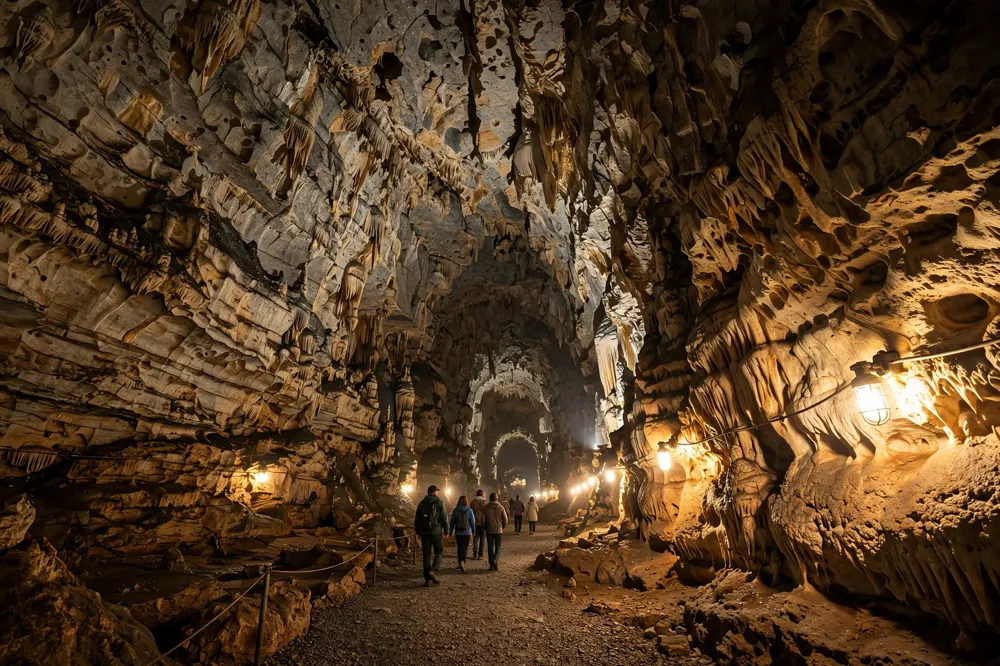
If you only take one tour, make it this one. Over about two hours and two miles, you walk through the cave’s giant main avenues, the same passages that made it famous in the 1800s. You will see the old saltpeter mining works, squeeze through a low passage cheerfully known as Fat Man’s Misery, and stand in vast chambers that swallow the beam of the ranger’s lantern. It is moderate in difficulty, with a fair number of stairs, and it gives you the real scale of the place.
Frozen Niagara: the pretty one, and the family favourite
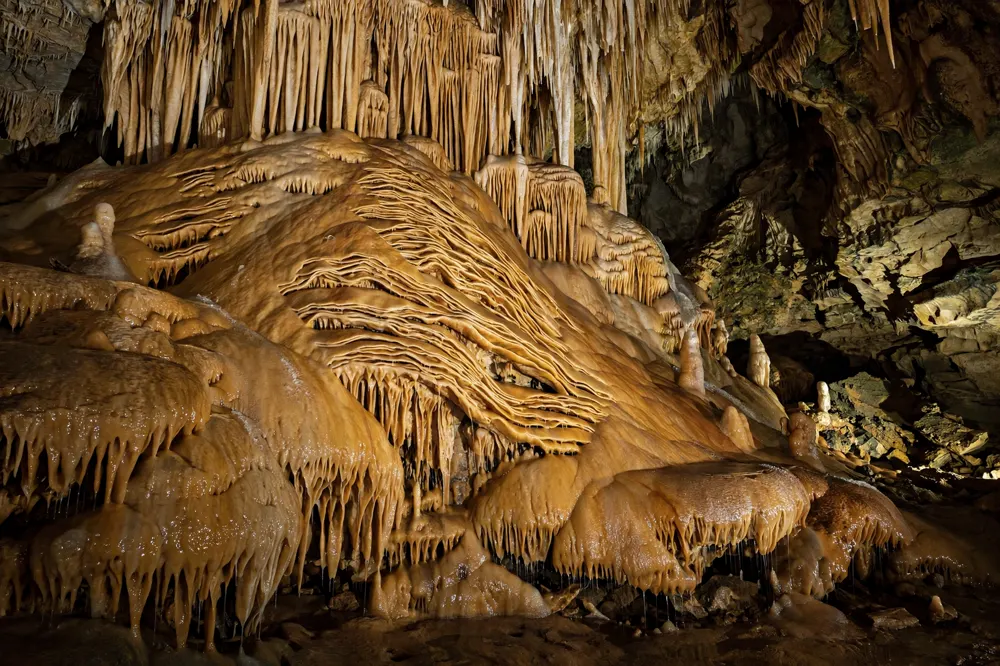
This shorter tour, usually around an hour and a quarter, focuses on the cave’s decorated section, where stalactites, stalagmites and flowstone cover the walls. The star is Frozen Niagara itself, a towering flowstone formation that looks like a waterfall stopped mid pour. With fewer stairs and a shorter distance, it suits families with younger children and anyone short on time.
Going deeper: Domes and Dripstones, Grand Avenue and the Wild Cave Tour
Domes and Dripstones descends a long series of staircases through vertical shafts before reaching the dripstone displays, and involves around 500 steps. Grand Avenue is a longer, more demanding walk of several hours through some of the biggest passages in the cave. At the far end of the scale, the Wild Cave Tour is a genuine expedition: around five miles of crawling, climbing and squeezing over roughly six hours, with helmets and lights provided. You will get muddy, tired and very happy. Book it only if you are fit and untroubled by tight spaces.
Booking: the One Thing You Must Do Early
Cave tours are booked through Recreation.gov and can be reserved up to six months ahead. In summer and on holiday weekends, popular tours sell out days or weeks in advance, and walk up tickets are often gone by mid morning. The full tour schedule is sometimes only published one to three months before the date, so check back if your preferred tour is not listed yet. Book the cave tour first, then build the rest of your trip around it.
What to Know Before You Go Down
The cave stays at a steady 54 degrees Fahrenheit, about 12 degrees Celsius, all year, so bring a light jacket or sweater even in July. Wear closed toe shoes with decent grip. Paths are mostly gravel or paved, but they can be damp. Some tours have strict rules about bags and items carried, and all visitors go through a simple cleaning station for their shoes when leaving, which helps protect bats from white nose syndrome, a fungal disease that has hit bat populations hard across North America. Do not skip it, and never wear the same gear you have used in another cave without cleaning it first.
Above Ground Is Worth Your Time Too
The park protects more than 52,000 acres of forested hills and the Green River valley. There are hiking trails from short loops to long backcountry routes, river access for paddling and fishing, campgrounds, and a lodge inside the park. On a two day visit, a morning cave tour followed by an afternoon hike to a sinkhole or spring is a great rhythm, and spring and autumn bring wildflowers and fall colour respectively.
Best Time to Visit
Tours run all year except Christmas Day. Spring and autumn offer the best balance of mild surface weather and smaller crowds. Summer is the busiest season, when booking early really matters. Winter visits are quiet and atmospheric, with fewer tour options but a peaceful park. Whatever the month, the cave itself never changes: always cool, always dark, always astonishing. Give it a full day if you can. Mammoth Cave earned its name honestly.