Reed Flute Cave: Inside Guilin’s Colourful Underground Palace
Some caves impress you with darkness and silence. Reed Flute Cave does the opposite. Step off a hillside path just outside Guilin in southern China and you walk into a stone hall washed in pink, violet, green and gold light, where stalactites hang like frozen waterfalls and a still underground lake doubles everything in reflection. It is theatrical, a little surreal, and completely unforgettable. Locals call it the Palace of Natural Arts, and honestly, the name fits.
Reed Flute Cave sits on Guangming Hill, about 5 kilometres northwest of central Guilin in Guangxi province. That short distance matters. Many of China’s great caves demand a long bus ride into the mountains, but this one is practically a city attraction. You can visit in the morning and still be back in town for lunch, which is exactly what generations of travellers have done.
Why It Is Called Reed Flute Cave
The cave takes its name from a type of reed that once grew thickly around its entrance. Villagers cut the reeds and hollowed them into simple flutes, and the name stuck. The cave itself is far older than any flute, though. Geologists estimate the limestone formations began developing around 700,000 years ago, as underground water slowly dissolved the rock and then redeposited it, drip by drip, into the shapes you see today.
People have been visiting for a very long time. More than 70 ancient inscriptions survive on the cave walls, the oldest dating to 792 AD during the Tang dynasty. Travellers, poets and officials carved their impressions into the stone, which makes Reed Flute Cave one of the most historically documented show caves in China. During wartime, local people also used it as a refuge. After renovation work, it reopened to the public in the early 1960s and has welcomed tens of millions of visitors since, including a long list of foreign heads of state.
What You Will See Inside
The visitor route is a one way walking path of roughly 500 metres through a series of connected halls. The cave itself extends about 240 metres in depth, and at a comfortable walking pace most people spend 40 minutes to an hour underground. Chinese show caves follow a charming tradition: every notable formation gets a poetic name, and guides point them out one by one. Half the fun is tilting your head, squinting a little, and suddenly seeing the shape appear.
The Named Formations
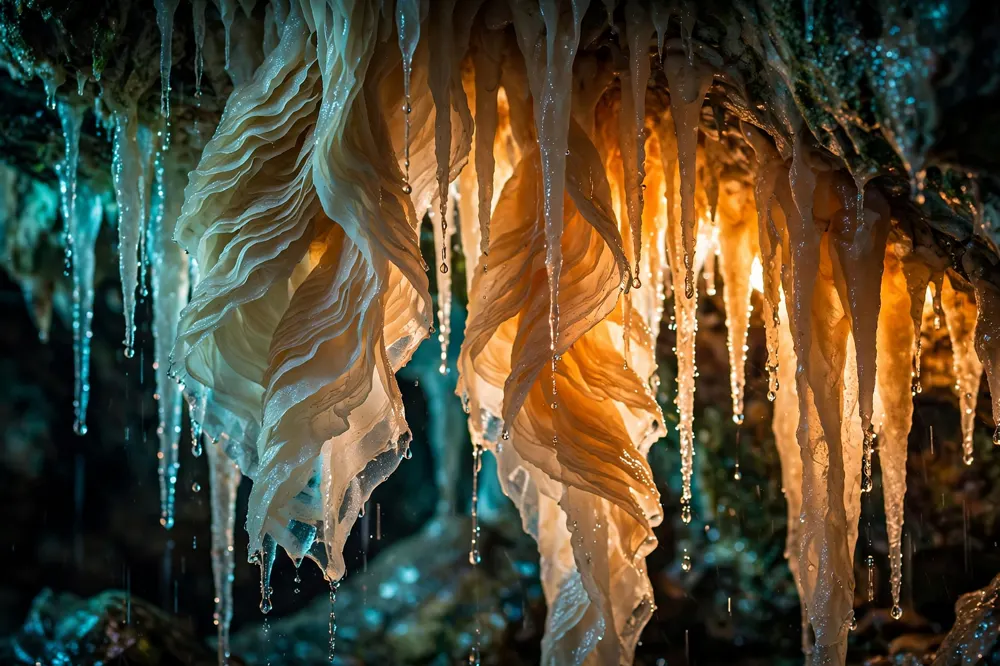
Along the route you will pass the Dragon Pagoda, the Virgin Forest, Flower and Fruit Mountain and a lion said to be watching the sunrise. Delicate stone curtains hang in folds from the ceiling, thin enough that light glows through them. Elsewhere, clusters of stalagmites rise like pine trees dusted with snow, and hollow stones along the path have earned musical names over the centuries, including the stone drum and the stone bell.
The Crystal Palace
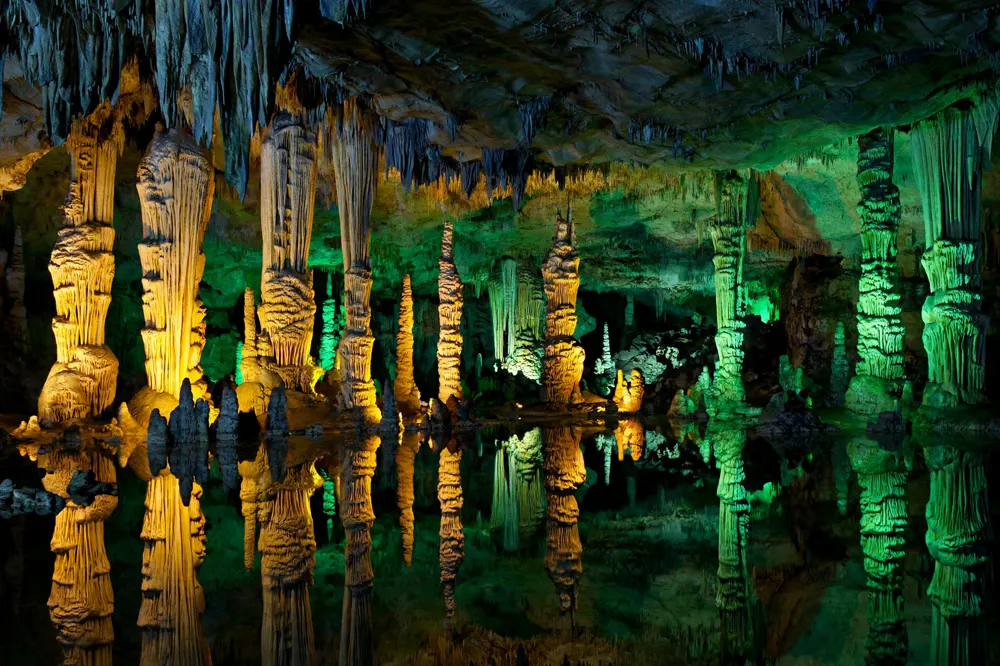
The route builds towards its biggest chamber, the Crystal Palace. This enormous hall stretches roughly 93 metres across and rises about 18 metres high, covering some 3,000 square metres. A calm underground lake fills part of the floor, and the coloured lights reflect off the water so perfectly that the stalactites seem to continue below the surface. It is the photograph everyone takes, and standing there in person, it is easy to understand why the chamber has hosted grand occasions. Give yourself a few quiet minutes here before the path leads you out through a separate exit nearby.
A Note on the Coloured Lights
Let us be honest about the lighting, because it divides opinion. Reed Flute Cave does not do subtle. Formations are bathed in saturated colour that changes from hall to hall, and purists who prefer their caves lit in plain warm white may find it over the top. Most visitors, though, love it. The colours make the shapes of the formations pop, they photograph beautifully, and they suit a cave that has been presented as a natural palace for over a thousand years. Go in expecting a show rather than a science exhibit and you will enjoy it far more.
How to Get There
Getting to Reed Flute Cave is simple. City bus number 3 runs from central Guilin towards the cave, and a taxi or a DiDi ride hail from downtown takes roughly 15 minutes depending on traffic. Many visitors combine the cave with a walk around nearby Peach Blossom River or a wider Guilin city tour, since the karst peaks that make this region famous rise all around the area.
Best Time to Visit
The cave keeps a steady temperature of about 18 to 20 degrees Celsius all year, so it feels pleasantly cool on a humid Guilin summer day and mild in winter. Opening hours run longer in the peak season, roughly April to November, and a little shorter in winter, so check the current schedule before you go. Tour groups arrive in force from late morning onwards. Arrive near opening time, ideally on a weekday, and you will have the halls at their quietest. Guilin’s rainy season can make the paths outside slippery, though the cave itself is an excellent wet weather plan.
Practical Tips for Your Visit
Tickets and Tours
A standard adult ticket costs around 90 yuan at the time of writing, and booking a day ahead through Chinese travel platforms sometimes trims a little off the gate price. Guided groups set off regularly and are usually led in Chinese, with commentary at each named formation. Independent travellers can simply follow the one way route at the pace of the group ahead.
What to Wear and Bring
The floor inside is paved but can be damp, and there are steps along the route, so wear shoes with decent grip and leave the heels at the hotel. Bring a light layer even in summer, as the temperature drop at the entrance is noticeable. Photographers should skip the flash. The cave’s own lighting is the whole point, and a phone on night mode will capture the colours far better than a harsh burst of white light.
Reed Flute Cave is not the biggest cave in China, and it does not pretend to be. What it offers is a concentrated hour of colour, story and spectacle, wrapped in twelve centuries of visitor history and sitting almost inside a city. If you are in Guilin for the Li River and the karst peaks, carve out a morning for the palace underground. It earns its place on the itinerary.