Skocjan Caves: A River Canyon Hidden Deep Inside the Earth
There is a moment on every Skocjan Caves tour when the group goes quiet. You have walked through a silent, beautiful dry cave, following your guide’s lamp, and then the passage opens out and the ground simply falls away. Far below, in a gorge so large your brain first reads it as an outdoor valley, a river roars over rapids. A bridge crosses the void high above the water. Except you are not outdoors. You are deep underground, standing inside one of the largest cave canyons on the planet.
The Skocjan Caves lie near the village of Matavun in southwestern Slovenia, within the 413 hectare Skocjan Caves Regional Park. In 1986 UNESCO added the system to the World Heritage List, ranking it alongside the great natural wonders of the world. It is not hard to see why. This is the landscape where the scientific study of karst began, and the word karst itself comes from this very region of limestone hills and disappearing rivers.
A River That Vanishes Underground
The architect of Skocjan is the Reka River. The Reka flows across the surface, then sinks into the karst and travels underground through the cave system before continuing its hidden journey towards the Adriatic. Over immense spans of time, the river carved a canyon inside the mountain more than 100 metres deep, and where cave roofs collapsed it left behind enormous dolines, steep sided hollows where daylight reaches the cave entrances and rare plants grow in pockets of strange microclimate.
The centrepiece is Martel Chamber, named for the French speleologist who explored these depths in the 19th century. It measures over 300 metres long and up to about 146 metres high, with a volume of some 2.2 million cubic metres, placing it among the largest known underground chambers in the world. Numbers that big are hard to feel from a page. Standing on the path cut into its wall, with the river reduced to a bright thread of foam far below, you feel every one of them.
What the Guided Tour Is Like
All visits to Skocjan are guided, and photography inside the cave is not allowed, a rule that protects the fragile environment and, honestly, improves the visit. With nobody stopping for selfies, the whole group stays present, listening to the river and the guide. From the visitor centre you walk to the cave entrance, descend through a short tunnel, and enter the first great section.
The Silent Cave
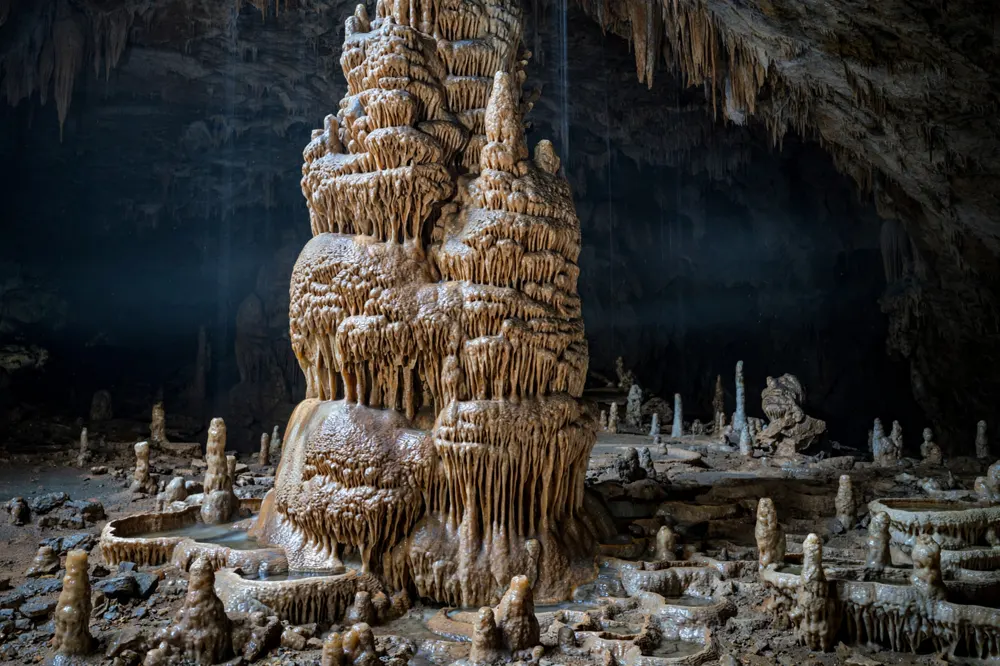
The tour begins in the Silent Cave, a dry fossil passage filled with formations. Stalagmites crowd the floor like a stone congregation, and among them stands the Giant, a stalagmite around 15 metres tall. The lighting here is deliberately restrained. Shapes emerge slowly from the gloom, and the only sound is footsteps and dripping water. It is lovely, calm and grand in an ordinary show cave way. Enjoy it, because it is the quiet before the storm.
The Murmuring Cave and Cerkvenik Bridge
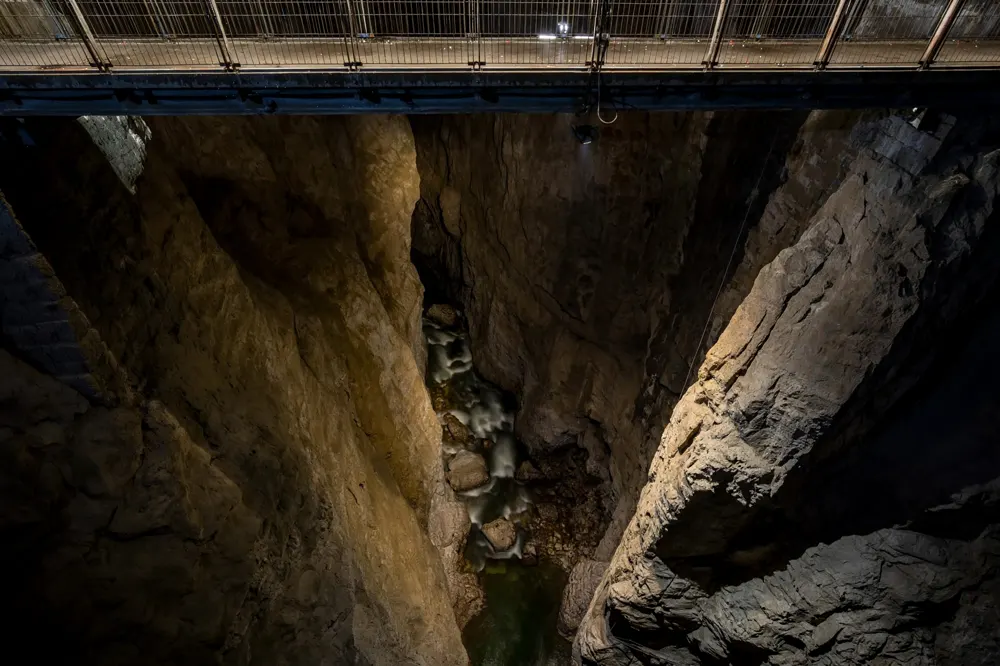
Then the path descends into the Murmuring Cave, and the sound arrives. The Reka fills the air with a deep, constant rumble as the canyon opens around you. The walkway clings to the canyon wall, and midway you cross Cerkvenik Bridge, suspended roughly 45 metres above the river. Looking down into the foam and up into blackness that swallows your guide’s light whole, most people grip the rail for a second. The bridge is perfectly safe and completely thrilling.
After the canyon, the tour climbs back towards daylight. Near the exit you can choose between return routes of different lengths, from a short walk of about 10 minutes to a fuller trail of around an hour that passes waterfalls, natural bridges and the openings of side caves in the collapsed dolines. Take the longer option if your legs allow it. The dolines, with their sheer walls and pockets of Mediterranean and alpine plants growing side by side, are a wonder in their own right.
Do not rush off the moment you surface, either. The wider regional park above ground deserves an hour of your time. An education trail loops through the villages of Skocjan and Matavun and past barns, wells and small museum collections that explain how people farmed this stony land and how explorers first descended into the caves with ladders, ropes and nerve. The collapsed dolines shelter a tangle of plant life, where Mediterranean and alpine species grow within a short walk of each other thanks to the sheltered microclimates. After the drama underground, the quiet stone villages and big Karst skies round the visit out beautifully.
How to Get There
Skocjan is easy to reach in southwestern Slovenia, close to the town of Divaca, which has a railway station, and a short drive from the Italian border and the port city of Trieste. Drivers follow signs for Matavun and the regional park, where the visitor centre handles tickets, tours in several languages and a small museum about the cave’s explorers. Many travellers combine Skocjan with nearby Lipica, home of the Lipizzaner horses, or with Postojna Cave. The two great Slovenian caves make a fascinating pair: Postojna is polished and playful, Skocjan is raw and immense.
Best Time to Visit and Practical Tips
Tours run all year, and the cave temperature stays around 10 to 12 degrees Celsius, so a warm layer and shoes with strong grip are essential in every season. The tour involves several hundred steps and sustained walking on paths above steep drops, so it asks more of visitors than Postojna does. Reasonable fitness will serve you well.
Book ahead in summer, when popular departure times can sell out, and be aware that after very heavy rain the river runs high and wild, which makes the canyon even more dramatic, though tours can occasionally be adjusted for safety. Winter visits are quieter and moodier. Whenever you go, leave the camera expectations at the door, keep both hands free for the bridge, and let your eyes adjust. Skocjan does not need photographs. It leaves its pictures in your head, and they stay there for years.